
Pedro Cano Foundation and sketching
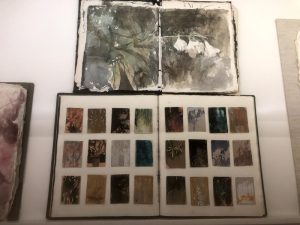
Took a walk down to the town to make a few sketches. Walking along the riverside I noticed a building called ‘The Pedro Cano foundation’. It was a very impressive large modern looking building so I decided to step inside and see what it was all about, as I had no idea. It turns out it was a large display over 3 floors of paintings and drawings by Blanca born artist Pedro Cano (https://es.wikipedia.org/wiki/Pedro_Cano). After looking at the ground floor display I was a bit apprehensive because I’ve been to places like this before and the work is quite insipid and definitely provincial and the collection here did resonate slightly on that wave length. Despite this, I proceeded up to the next floor to be greeted by a fantastic collection of very large paintings spanning a time scale from the late 1950s to present day. The artist clearly showed great draftsmanship and skill with lovely tonality and play with dark and light. The final floor had an interesting film interview with Pedro Canno. It showed him working on sketchbooks at many different locations around the globe. On this floor on display were a lot of his sketch books. It must be said that it was like looking at JMW Turner’s sketchbooks. All of the work was in watercolour and from what I could tell sketched with the paint, with no underlying drawing.
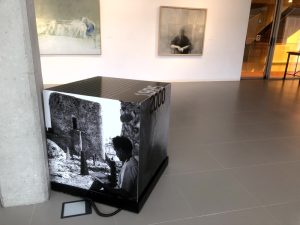


These are very beautiful and accomplished works. Don’t think I have seen such amazing treatment of light and dark. Making such decisions as to leave areas blank and not to over work areas is a skill in itself. I was very inspired by looking at the sketchbooks. I found it interesting to see al the different little studies of things, objects such as lemons on a tree for example. Sometimes it’s not all about trying to capture the whole big vista, but to pick a small thing and study it. This is something I’ve perhaps neglected myself. Perhaps with being time limited and never seeing to have enough time, it leads to the decision to capture an entire scene. The other thing I learned was how to make light talk. The strong Mediterranean sunshine illuminates everything and makes white even whiter! I bought a book of his work that shows studies made in Blanca and also an exhibition poster. Very happy to have discovered this artists and add him as an influence.



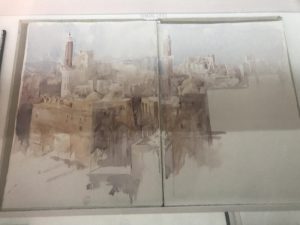
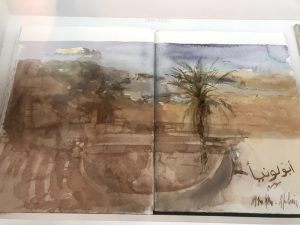

As with every trip to hot places, it takes a good few days to acclimatise. You find yourself getting into the routine of the place, making the most of the cool morning and taking it easy with a siesta in the hot mid afternoon. Straight after coming out of the Pedro Cano foundation, I did a couple of watercolour sketches that were an application of his technique. No underdrawing and no tracing the pencil underdrawing with a fine liner ink pen (which I do a lot), just pure colour onto the paper. Sketching with the colours straight from the watercolour pans. An incredible way of painting that requires a lot of concentration and thought. When you put a brush mark down, it’s got to be right otherwise it’s tricky to correct. It can build very good discipline in terms of actually looking at what you are painting and making each mark count.


I have of course experimented a lot in the studio with oil painting in the past. Its a more free process of creating the drawing using a mix of the white spirit and paint. If you make a mistake, you can quickly scumble it out. A couple of years ago I visited Norham castle on the banks of the River Tweed on the Scottish / English border. Reason why I went there was because JMW Turner visited Norham several times and made paintings of the castle. So I experimented with the watercolours, trying out wet on wet technique. I learned a lot from that study and when it’s best to apply wet on wet. It doesn’t work so well for architecture, but is great for creating atmospheric effects or tonal variations or shadow on a surface. So anyway, that’s what I did today and was happy with the result.